

Best Time to Cold Call B2B Prospects: Data & Time Zones
The best time to cold call depends on the buyer’s local time, role, and working pattern. Morning and late-afternoon windows are useful hypotheses to test; neither is a universal winner. Evaluate answered conversations and qualified meetings, not just dial volume.
This article includes historical Revenue.io call analysis and a practical way to run your own test. The older charts are historical observations, not a newly collected 2026 dataset.
How to Test Calling Times in Your Own Market
- Split comparable prospects by role, industry, region, and lead source.
- Rotate reps across time windows so rep skill does not determine the result.
- Record call time in the buyer’s verified local time zone; a phone area code alone may be misleading.
- Keep the opening message and qualification criteria consistent.
- Compare live connects ÷ attempts and qualified meetings ÷ attempts. Review sample size before declaring a winner.
- Repeat across multiple working days before changing the whole team’s schedule.
Use the B2B lead research checklist to confirm the person and context before calling. Timing helps only when the message is relevant.
Our Sales Team Thoughts
According to Jake Spear, Director of Sales at Revenue.io, their internal sales team consistently finds that calling prospects around 4 PM local time yields the highest connection rates.
‘By late afternoon, decision-makers tend to have wrapped up meetings and are more receptive to unexpected calls,’ says Spear.
This aligns with broader sales research indicating that the late afternoon often presents an optimal opportunity to engage buyers when their schedules are more flexible.
Why Knowing Peak Call Connection Times Is Critical for Sales Prospecting
Knowing when prospects are most likely to pick up the phone is critical. Even reps that dial all day long, should always be prioritizing their hottest outbound prospects during times when they are most likely to engage. Sales sequencing technology has made it easier than ever to schedule calls (and other sales outreach like emails and texts) during those key windows.
Experts agree, sales leader research from TOPO (now part of Gartner) reveals that sales leaders are prioritizing live call execution as the most important skill of new sales people. That is a leading indicator of the fact that sales development teams are still seeing cold calling as a valuable channel. The best time to make cold calls is an important part of live call execution, as calling at the right time can maximize your answer rate, thereby maximizing your sales conversations and ultimately opportunities.
What Time Should You Test for Cold Calls?
Test more than one window in the prospect’s local time. Earlier analysis on this page favored late afternoon for its sample; that result should not be applied automatically to every industry or buyer.
| Local-time window | Why test it | What to check |
|---|---|---|
| 8–11 a.m. | May reach buyers before their day fills with meetings. | Connect and qualified-meeting rates for your segment. |
| 3–6 p.m. | May reach buyers after meetings wind down. | Whether buyers actually work during that window. |
| A segment-specific alternative | Some roles follow shift schedules or different business hours. | Local working hours and response patterns. |
Prior Research – When is the best time to cold call?
Our research showed that the best time to call prospects (in their own time zone) was in the late morning.
Cold calling in the morning makes sense for several reasons. Working professionals start their day at varying times, but the majority are in the office by the late morning.
While meetings often get booked during these hours, that means this is the time of day that professionals are expecting to hear from people, which may make them more likely to answer the phone.
Check out this chart for a detailed breakdown:
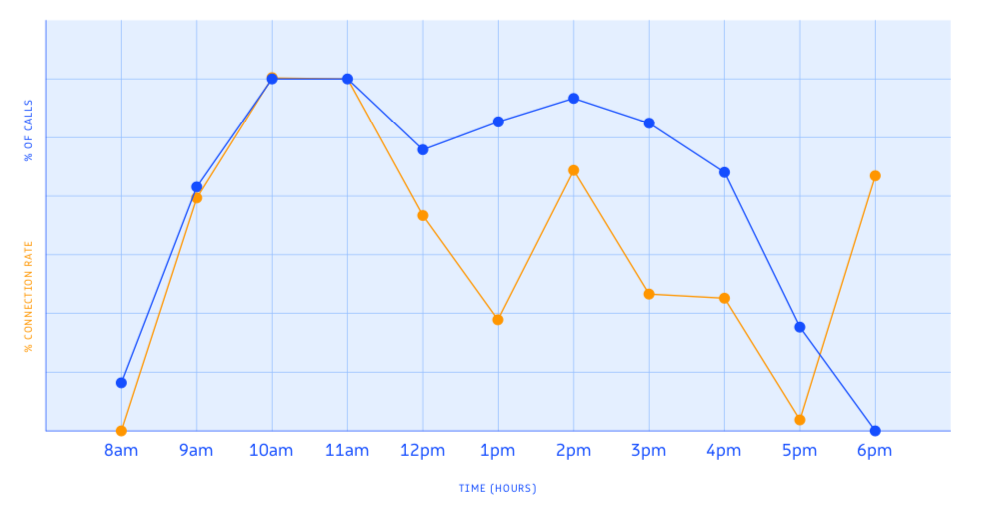
Keep in mind that this data is for all calls made through the Revenue.io platform in the past – that includes calls made between business professionals who have pre-existing relationships. For most sales reps, a more helpful chart would be to examine cold calls specifically (see our recent research above).
Best time to call based on call data
According to our past call data, the best time to cold call was shown to be 9am in the call recipient’s local time zone.
Call connection rates were highest between 8am-11am in the time zone of the person receiving the call.
That means that sales development reps or anyone making prospecting calls could try structuring their day by prioritizing morning sessions for call blocks with their dialer or sequence tools during these windows.
Check out this chart for a detailed description of when most teams make cold calls and when prospects are picking up the phone, according to our research.
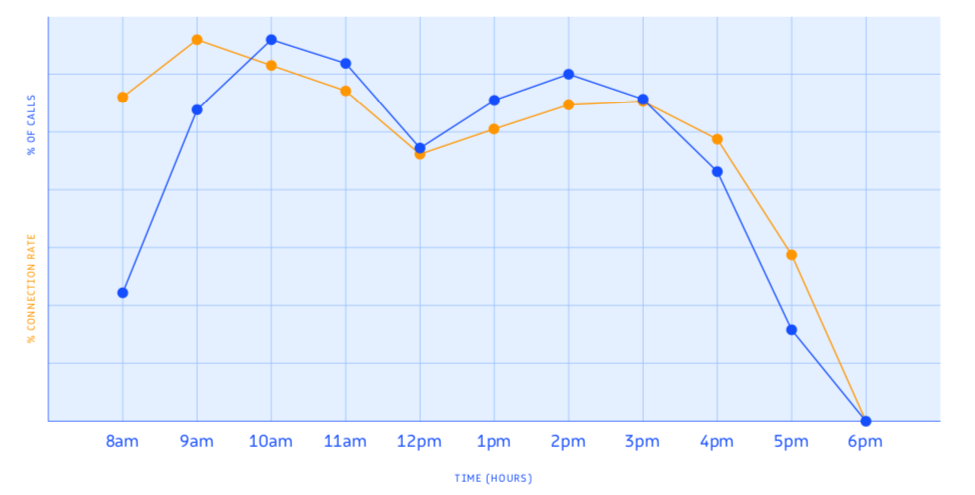
Sales reps shouldn’t necessarily avoid making calls during times of lower connection rates – those lower connection rates are simply times when prospects are less likely to pick up the phone, but that doesn’t mean they will never answer the phone at that time. The idea is simply to prioritize the best prospects for windows in which they are most likely to pick up.
The best time to make prospecting calls based on time zone
The best time to make prospecting calls during the day is whenever your target leads are picking up the phone. This means it is very important to structure your day according to your sales territory’s working hours, and make your calls during their peak connection rates. For example, if you are based on the east coast of the United States but calling in to the west coast, the data shows that you should begin making your prospecting calls at 11am, and continue calling through 6 or 7pm to ensure you are taking full advantage of the times that your prospects are answering the phone.
When is the worst time to call prospects?
The worst time to call prospects is outside of working hours. During these times, not only are connection rates lower, but a phone call is likely to bother your prospects. Calling prospects during their personal time is usually inadvisable.
During working hours, the worst time to call prospects is around 1pm. Depending on their work day, most prospects are spending time eating out with colleagues, taking a break, or getting some much needed focus time during these hours.
This answer rate also coincides with the energy drop-off that research shows is common among working professionals just after lunch. Many of us experience an energy lull during this time, and it makes sense that we are less willing to engage with someone unknown on the phone at this hour.
How can you make data about the best time to call leads actionable?
Now that we have worked through several different ways to think about optimal times to cold call businesses and prospects, what do we do with the information?
Our best advice for sales reps looking to reach more customers consistently is to schedule the day around call blocks, and treat these metrics as benchmarks.
For time blocks, set aside an hour at a time for your prospecting calls, several times throughout the day. If these are just standard call blitzes or steps in a sales cadence, ensure that you have your prospect lists ready to go, with phone numbers, names, and all of the contextual history of their engagement with your company. Then, when the time of your scheduled call block arrives, you are ready to begin dialing through your list and don’t have to waste your time doing prospect research.
Potential Pitfalls
There are many pitfalls that can capture a salesperson’s time, keeping them from spending their focused effort where it matters. If you can keep the discipline of call blocks during peak connection times, you are more likely to reach your customers and generate more opportunities for your pipeline.
Keep in mind that these data points are best used as benchmarks – in other words, they are a helpful starting place for making decisions about how to spend your time. As a part of your sales management process It is extremely important that you begin collecting your own data about peak connection rates, as your specific market and target audience will have nuances and differences from data points generalized across many industries.
Whether you find the best results in the late morning or the afternoon could depend on so many factors. But it’s important to experiment and, most of all, measure results by time of day. The Revenue.io platform makes it easy to track call connection rates by time of day. In fact, we deliver turnkey reports that teams can start using almost instantly.
Cold Calling Phone Tactics
Successful inside sales reps find themselves wearing many hats. During prospecting you take on the role of a private investigator. When sending follow-up emails, you must weigh each word carefully like a poet. But the best sales reps are also much like behavioral psychologists, acquiring data about the way prospects operate and searching for patterns.
 Recently, we cited a study revealing that more key decision makers are willing to pick up the phone for certain types of inside sales calls, creating increased opportunities for reps at B2B companies. But to maximize your chances of adding each prospect to your pipeline, you don’t just need to know who to call – you need to know when to call.
Examining the Data
A basic understanding of how businesses work can offer insights to intuitive B2B sales reps. For example, it makes sense that an executive might be easier to reach directly following standard work hours, after admins have left for happy hour. But as sales teams become increasingly data-driven, intuition alone won’t suffice. For the best results, inside sales teams need to embrace an evidence-based prospecting strategy. Here’s some data that can help you identify key prospecting windows.
An MIT study reveals that:
- 4-6pm is the best time to make contact with a lead (114% higher than the worst time block)
- 8-9am and 4-5pm are the best times to qualify a lead
- Wednesdays and Thursdays are the best days to make contact with a lead (Friday is the worst day)
- Thursday is the best day to contact a lead in order to qualify the lead
- The worst times to contact and qualify leads are during lunch/crunch time (11am-2pm)
Call Blitzing – Even on Holidays
During these call windows, when leads are more likely to be available, we recommend that B2B sales reps go for the gusto and dial as many leads as possible. This is known as a call blitz. The data indicates reps should kick their prospecting into overdrive on Wednesday and Thursday between 8-9am and 4-6pm.
When trying to reach top-level executives, some sales leaders also recommend calling after hours. In an HBR article, Vorsight’s Steve Richard recommended “call blitzing during ‘call windows,’ before 8:30 am and after 5:30 pm when admins are gone.”
Richard also champions call blitzing on holidays. It’s quite common for executives to work during holidays when lower-level staff members are on vacation. Weekends can even be a good time to access executives, as many businesses are moving away from standard corporate hours. This is especially true of companies like software startups and advertising agencies.
Gather Your Own Intelligence
Examining data from MIT or reading thought leadership pieces like Steve Richard’s can help you formulate a more effective prospecting strategy. But at the end of the day, businesses need to gather their own sales intelligence data in order to build an evidence-based strategy. Depending on your industry, you might find that Friday is the most effective day to dial leads. You might also discover that more calls end in opportunities during the early afternoon. The point is that if sales managers aren’t tracking call metrics in a CRM, it’s impossible to truly know when leads are entering the pipeline. Revenue.io gives sales managers real-time visibility into when reps are contacting decision makers, and the outcome of those calls. By closely monitoring call metrics, sales teams can build a prospecting strategy that enables maximum engagement with prospects.